Ancient India Class 03
Later Vedic Age (1100-600 BC) (5:09 PM)
- Aryans expanding to whole of ganga yamuna doab region.
- Kurus occupied the region around Hastnapur and adjoining areas.
- This age signifies the faint beginning of town life, for example, Hastinapur, Kosambhi, Mathura, Ayodhya, and Indraprastha were some of the early towns.
- The use of Iron occurred on an extensive scale.
- Economy:
- Agriculture became the most important activity.
- The term for Iron is Shyam Ayas.
- Shatpat Brahaman's commentary in Yajurveda speaks at length about farming rituals.
- This age also witnessed diverse art and craft tradition.
- Polity:
- The tribal authority became territorial.
- The position of Rajan became powerful.
- Tribal assemblies continued but now were controlled by warriors and brahmans.
- Bali became obligatory.
- An official known as "Sangrihitri" was appointed to collect taxes and tributes.
- 3 sacrifices became very popular:
- Aswamegha- unquestioned control over an area in which the royal horse ran uninterrupted.
- Raj Suya- it occurred during coronations for conferring the supreme powers on the king.
- Vajpeya- A chariot race in which the royal chariot was made to win against the kinsmen of the king.
- Society:
- Varna's system became rigid.
- 4th Varna was denied both Upnayana and Reciting Gayatri Mantra.
- Upanayana provided the status Dwaja(Twice born).
- The position of women declined.
- they were no longer allowed in tribal assemblies.
- Women were also denied both Upnayana and Reciting Gayatri Mantra.
- The institution of Gotra(a place where cattle belonging to the entire clan are kept and later signified descent from a common ancestor) emerged during this period.
- Gotra Endogamy was not allowed.
- The concept of 4 Ashram also immersed and signified life in 4 phases- Gristha(household life), Brahamancharya(to attain knowledge), Vanaprastha(partial renunciation), and Sanyasa( partial renunciation).
- Religion:
- Cult of sacrifice became more important than reciting prayers.
- Sacrifier was called Jajaman.
- Indra and Agni lost their importance and Prajapati, Rudra and Vishnu emerged as the main gods.
- Towards the end of the Vedic period, there was a strong reaction to priestly dominance which led to the compilation of many Upanishads that criticized rituals and emphasized on right lives and knowledge
- These settlements with access to agricultural produce, regular taxation, and extensive use of iron led to the emergence of small territorial states called Janpads.
- the term Janpad for the 1st time is mentioned in Brahaman literature around 800 BC.
- Some of these Janpads became larger kingdoms and were called Mahajanpads.
Mahajanpada period (600-300 BC) (6:12 PM)
- Sources:
- Epics.
- Puranas.
- Dhramsastra.
- Buddhist Literature:
- The earliest Buddhist literature is called Tripitaka:
- Sutta Pitaka:
- It contains a saying of Buddha himself.
- Complied just after the death of Buddha.
- Vinay Pitaka:
- Rule of monks and nuns of Buddhist sangha.
- It also contains the list of transgressions called Pratimokha and atonement for them.
- Abhidhamma Pitaka:
- It is a later work and contains philosophical enquires along with answers.
- Jatka stories:
- Stories of the previous birth of Buddha.
- Theragatha and Therigatha:
- Songs from Buddhist monks and nuns.
- Therigatha is the oldest text written in India from the perspective of women.
- Jains literature:
- They are collectively known as Siddhanta or Agam.
- Some early works are Bhagwati Sutra and Parishishtparvam among others.
- Ashtadhyayi by Panini:
- Panini was a Grammarian and his work Ashtadhyayi is one of the most intellectual achievements of ancient India.
- He belonged to the Gandhara region and studied at the university of Taxila.
- Even though it is a book of grammar it deals with places, people,c customs, coins, weights, and measures.
- Ancient Text mentioned 16 Mahajanpads.
16 Mahajanpads (6.52 PM)
- Diagramatic representation for Mahajanpadas:
-
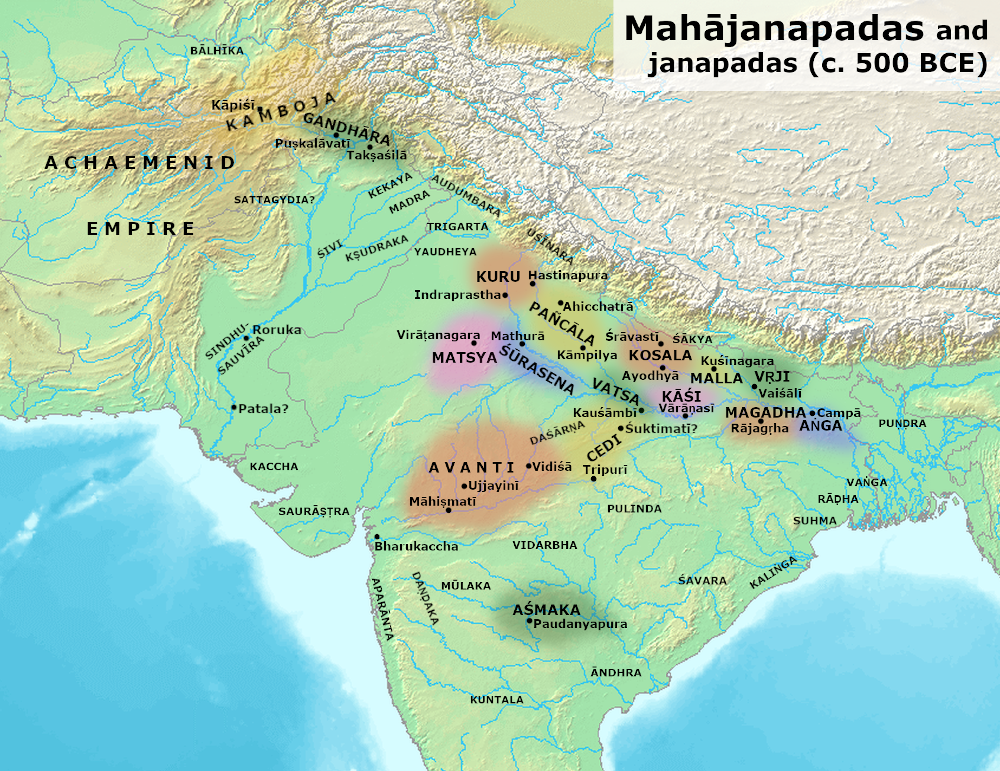
- Asmaka:
- South most mahajanpada.
- Situated near the Godavari and its capital was Podana/Potli.
- An ancient town called Pratiasthana was the capital of a Janpad named Mulag which was near asmaka.
- Anga:
- It includes the Munger and Bhagalpur regions of Bihar.
- It was near the Champa river.
- Its capital was also named Champa.
- Avanti:
- Situated in central India.
- It had 2 important cities- Mahismati and Ujjani.
- It was ruled by Pradiyot Dynasty.
- Cedi:
- It is in the Bundelkhand region.
- Its capital was Sothivottinagar.
- Gandhara:
- It included modern Peshawar and Rawalpindi in Pakistan.
- Its capital was Taxila(which became a great centre of learning).
- It was conquered by the Persian king Darius in the 6th century BC.
- Kamboj:
- It includes the Hazara region of Pakistan and the Kafiristan region of Afghanistan.
- Kashi:
- It was bound by Varun and Assi rivers.
- Its capital was Varanasi.
- Kosala:
- It was divided by the Saryu river into 2 parts,
- Its capital was Sharvasti while Ayodhya and Saket were important cities.
- Kuru:
- It was ruled by the Yuddisthilla family from the clan Yudhishthira belongs to.
- Its capital was Indraprastha.
- Magadha:
- It included the region of Patna and Gaya of Bihar.
- It later emerged as the most powerful Mahajanpada.
- Malla:
- It has 2 power centres Kushinagar(Buddha passed away here) and Pava.
- Matsya:
- Located near Jaipur in Rajasthan.
- The territory included Alwar and Bharatpur also
- Capital was Viratnagar.
- Panchal:
- It was divided into 2 parts by Ganga.
- It had two capital- Ahichhatra and Kampilya.
- Kanyakubja(Modern Kannuj) was also part of the kingdom.
- Shurasena:
- Its capital was Mathura.
- It maintained good relations with Avanti,
- Vajji:
- It was a confederacy of 8 clans.
- The most powerful clan was the Licchavi clan.
- The capital was Vishali.
- Licchavi clan was led by Chetak who was the bother of Trishala(Mother of Mahavir).
- The daughter of chetak was married to Bimbisara(ruler of Magadha).
- Vatsa:
- Its capital was Kusambhi.
- The ruler of Vatsa Udayana and the ruler of Avanti(Pradyota) had a rival relationship.
- Later Daughter of Pradyota was married to Udayana(the central plot of 3 romantic dramas- Swapnavasvadatta by Bhasa, Ratnavali, and Pryidarsikha by Harshvardhan).
- Magadha, Kosala, Vatsa, and Avanti were the most powerful Mahajanpadas.
- Magadha emerged as the most powerful because of the following reasons:
- It lies in the extensive fertile plains of Ganga.
- The availability of Iron from the Chotanapgur Plateau led to large-scale agriculture and tools and weapons.
- Elephants were domesticated and included in the army.
- The early capital of Magadha had a strategic location surrounded by hills.
- Similarly, the later capital Patliputra was a water fort that is surrounded by rivers.
- Rulers were ambitious, pragmatic, and flexible in their outlook.
- Kirats and Madghas were seen as lower by others as recently vedisized and showed more zeal for the expansion of their kingdom.
- The political setup can be divided into 2 categories:
- Monarchy(king as an absolute authority)
- Oligarchy/Jansagha( rule by a group of people like Vajji).
Magadha-Harnayaka Dynasty (7:44 PM)
- Bimbisar (544-492 BC):
- He was a contemporary of Budhha and Mahavira.
- He maintained a standing army and started matrimonial alliances to strengthen the position of his empire.
- He fought with the ruler of Avanti(Pradayot Mahasena) however sent his court physician Jeevak when Pradayot was ill.
- He was killed by his son Ajatshatru who became the next ruler.
- Ajatshatru (492-460 BC)
- He was a contemporary of Budhha and Mahavira.
- He convened the 1st Buddist council after the death of lord buddha.
- He is the presumed inventor of 2 weapons- Rathmushal and Mahashilakantaka(engine to throw big stones).
- His son Udaya sifted the capital from Rajgraha to Patliputra.
The topic of the next class: Magadha to continue.